SeriesSeries
Watch The Mechanical Universe (1985) Online

No video is available for The Mechanical Universe - S1E1 yet. Check back soon.
Synopsis
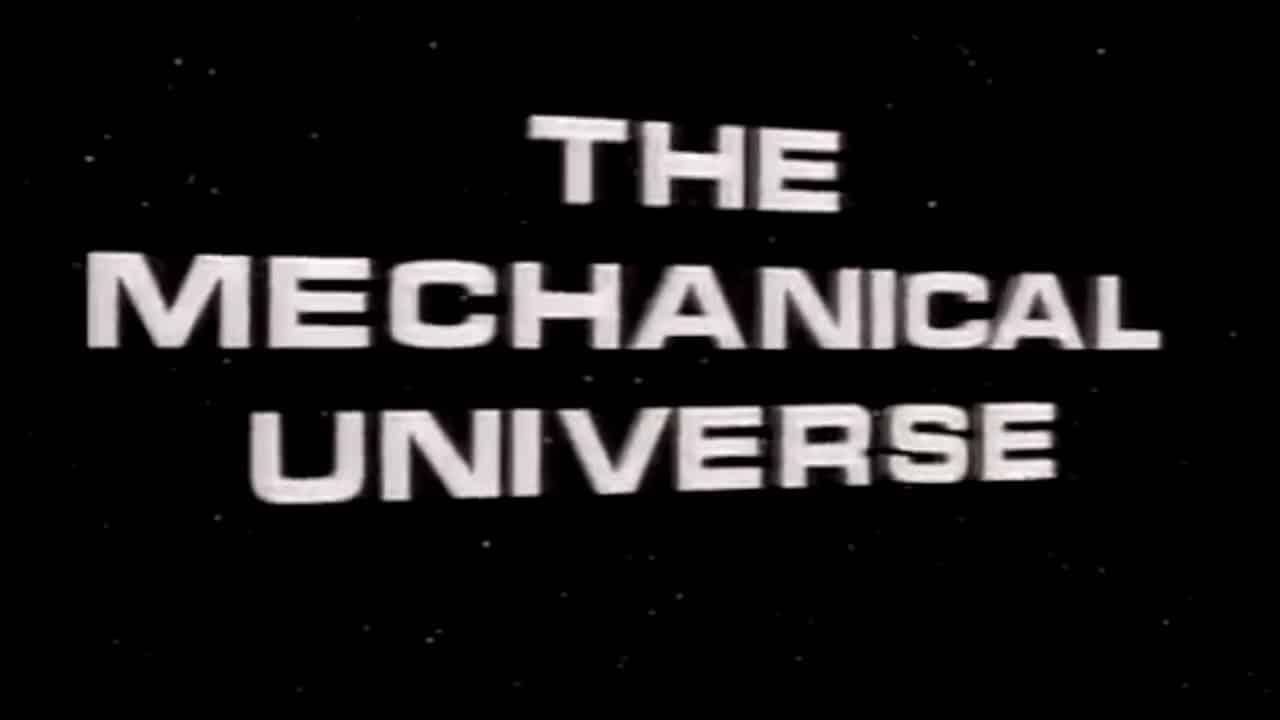
The Mechanical Universe... And Beyond, is a 52-part telecourse filmed at the California Institute of Technology, and produced by Caltech and INTELECOM Intelligent Telecommunications. The series introduces university level physics, covering topics from Copernicus to quantum mechanics. Produced starting in 1985, the videos make heavy use of historical dramatizations and visual aids to explain physics concepts. The latter were state of the art at the time, incorporating almost 8 hours of computer animation created by computer graphics pioneer Jim Blinn. Each episode opens and closes with a "phantom" lecture by Caltech professor David Goodstein. After more than a quarter century, the series is still often used as a supplemental teaching aid, for its clear explanation of fundamental concepts such as special relativity. The Mechanical Universe lectures are actual freshman physics lectures from Physics 1a and 1b courses at the California Institute of Technology. The room seen in the videos is the Bridge lecture hall. The series can be purchased, or viewed by streaming from the Annenberg website, or can be viewed on other video streaming sites such as YouTube and Google Video.
Episodes
Season 1
- 1. IntroductionNow viewing1985-01-01This preview introduces revolutionary ideas and heroes from Copernicus to Newton, and links the physics of the heavens and the earth.
- 2. The Law of Falling BodiesGalileo's imaginative experiments proved that all bodies fall with the same constant acceleration.
- 3. DerivativesThe function of mathematics in physical science and the derivative as a practical tool.
- 4. InertiaGalileo risks his favored status to answer the questions of the universe with his law of inertia.
- 5. VectorsPhysics must explain not only why and how much, but also where and which way.
- 6. Newton's LawsNewton lays down the laws of force, mass, and acceleration.
- 7. IntegrationNewton and Leibniz arrive at the conclusion that differentiation and integration are inverse processes.
- 8. The Apple and the MoonThe first real steps toward space travel are made as Newton discovers that gravity describes the force between any two particles in the universe.
- 9. Moving in CirclesA look at the Platonic theory of uniform circular motion.
- 10. Fundamental ForcesAll physical phenomena of nature are explained by four forces: two nuclear forces, gravity, and electricity.
- 11. Gravity, Electricity, MagnetismShedding light on the mathematical form of the gravitational, electric, and magnetic forces.
- 12. The Millikan ExperimentA dramatic recreation of Millikan's classic oil-drop experiment to determine the charge of a single electron.
- 13. Conservation of EnergyAccording to one of the major laws of physics, energy is neither created nor destroyed.
- 14. Potential EnergyPotential energy provides a powerful model for understanding why the world has worked the same way since the beginning of time.
- 15. Conservation of MomentumWhat keeps the universe ticking away until the end of time?
- 16. Harmonic MotionThe music and mathematics of periodic motion.
- 17. ResonanceWhy a swaying bridge collapses with a high wind, and why a wine glass shatters with a higher octave.
- 18. WavesWith an analysis of simple harmonic motion and a stroke of genius, Newton extended mechanics to the propagation of sound.
- 19. Angular MomentumAn old momentum with a new twist.
- 20. Torques and GyroscopesFrom spinning tops to the precession of the equinoxes.
- 21. Kepler's Three LawsThe discovery of elliptical orbits helps describe the motion of heavenly bodies with unprecedented accuracy.
- 22. The Kepler ProblemThe deduction of Kepler's laws from Newton's universal law of gravitation is one of the crowning achievements of Western thought.
- 23. Energy and EccentricityThe precise orbit of a heavenly body — a planet, asteroid, or comet — is fixed by the laws of conservation of energy and angular momentum.
- 24. Navigating in SpaceVoyages to other planets use the same laws that guide planets around the solar system.
- 25. Kepler to EinsteinFrom Kepler's laws and the theory of tides, to Einstein's general theory of relativity, into black holes, and beyond.
- 26. Harmony of the SpheresA last lingering look back at mechanics to see new connections between old discoveries.
- 27. Beyond the Mechanical UniverseThe world of electricity and magnetism, and 20th-century discoveries of relativity and quantum mechanics.
- 28. Static ElectricityEighteenth-century electricians knew how to spark the interest of an audience with the principles of static electricity.
- 29. The Electric FieldFaraday's vision of lines of constant force in space laid the foundation for the modern force field theory.
- 30. Potential and CapacitanceFranklin proposes a successful theory of the Leyden jar and invents the parallel plate capacitor.
- 31. Voltage, Energy, and ForceWhen is electricity dangerous or benign, spectacular or useful?
- 32. The Electric BatteryVolta invents the electric battery using the internal properties of different metals.
- 33. Electric CircuitsThe work of Wheatstone, Ohm, and Kirchhoff leads to the design and analysis of how current flows.
- 34. MagnetismGilbert discovered that the earth behaves like a giant magnet. Modern scientists have learned even more.
- 35. The Magnetic FieldThe law of Biot and Sarvart, the force between electric currents, and Ampère's law.
- 36. Vector Fields and HydrodynamicsForce fields have definite properties of their own suitable for scientific study.
- 37. Electromagnetic InductionThe discovery of electromagnetic induction in 1831 creates an important technological breakthrough in the generation of electric power.
- 38. Alternating CurrentElectromagnetic induction makes it easy to generate alternating current while transformers make it practical to distribute it over long distances.
- 39. Maxwell's EquationsMaxwell discovers that displacement current produces electromagnetic waves or light.
- 40. OpticsMany properties of light are properties of waves, including reflection, refraction, and diffraction.
- 41. The Michelson-Morley ExperimentIn 1887, an exquisitely designed measurement of the earth's motion through the ether results in the most brilliant failure in scientific history.
- 42. The Lorentz TransformationIf the speed of light is to be the same for all observers, then the length of a meter stick, or the rate of a ticking clock, depends on who measures it.
- 43. Velocity and TimeEinstein is motivated to perfect the central ideas of physics, resulting in a new understanding of the meaning of space and time.
- 44. Mass, Momentum, EnergyThe new meaning of space and time make it necessary to formulate a new mechanics.
- 45. Temperature and Gas LawsHot discoveries about the behavior of gases make the connection between temperature and heat.
- 46. Engine of NatureThe Carnot engine, part one, beginning with simple steam engines.
- 47. EntropyThe Carnot engine, part two, with profound implications for the behavior of matter and the flow of time through the universe.
- 48. Low TemperaturesWith the quest for low temperatures came the discovery that all elements can exist in each of the basic states of matter.
- 49. The AtomA history of the atom, from the ancient Greeks to the early 20th century, and a new challenge for the world of physics.
- 50. Particles and WavesEvidence that light can sometimes act like a particle leads to quantum mechanics, the new physics.
- 51. From Atoms to QuarksElectron waves attracted to the nucleus of an atom help account for the periodic table of the elements and ultimately lead to the search for quarks.
- 52. The Quantum Mechanical UniverseA last look at where we've been and a peek into the future.
Cast
Top Billed Cast
No cast is listed for The Mechanical Universe.
Availability
Where To Watch Legally
No legal streaming, rental or purchase options for The Mechanical Universe were reported for this region.
Recommended
More Like This
FAQ
Frequently Asked Questions
Is The Mechanical Universe available to watch online?
Vidbox does not currently have a legal streaming, rental or purchase option on record for The Mechanical Universe in this region.
How many seasons does The Mechanical Universe have?
The Mechanical Universe has 1 season and 52 episodes.
When did The Mechanical Universe first air?
The Mechanical Universe first aired in 1985.
Is The Mechanical Universe still running?
The Mechanical Universe's status on TMDB is: Ended.
What genre is The Mechanical Universe?
The Mechanical Universe is classified as Documentary.